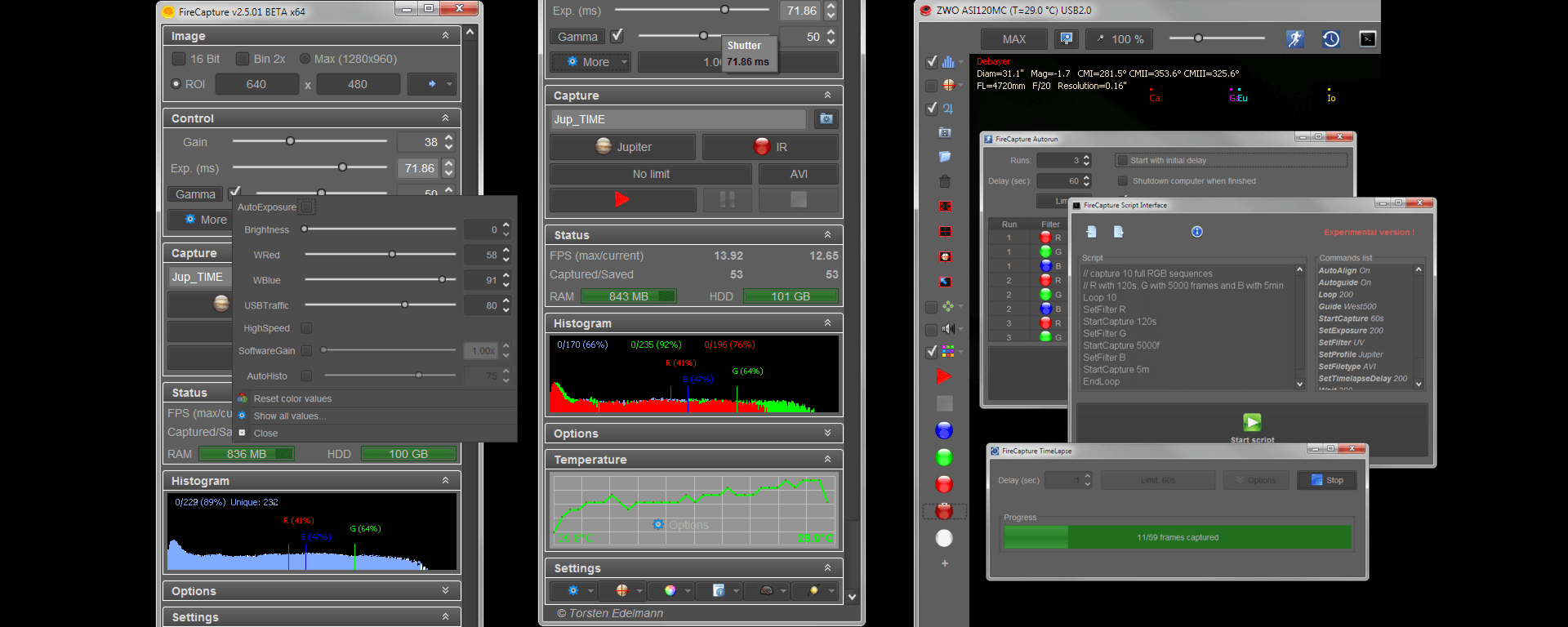
Raspberry support for FireCapture v2.6 and ZWO cameras !
| Compatibility |  FC v2.7.15 (x64) |
 FC v2.7.15 (x64) |
 FC v2.7.15 (x64) |
FC v2.7.15 (aarch64) |
|
|---|---|---|---|---|---|
 Altair Altair |
 |
 |
|
|
|
 ASCOM ASCOM |
 |
|
|||
 Basler Basler |
|
|
|||
 FLIR/FlyCap FLIR/FlyCap |
 |
|
|||
| FLIR/Spinnaker |
|
|
|||
 LUCID LUCID |
|
|
|||
 NexImage NexImage |
|
|
|||
 OGMA OGMA |
|
|
|
|
|
 PlayerOne PlayerOne |
|
|
|
|
|
 QHY QHY |
|
|
|
|
|
 Skyris Skyris |
|
|
|||
 SVBony SVBony |
|
|
|
|
|
 TIS
TIS |
|
|
|||
 Touptek/Omegon Touptek/Omegon |
|
|
|
|
|
 ZWO ASI ZWO ASI |
 |
|
|
|
|
Older Versions
Developing software is mostly fun, but it also takes up nearly all of my spare time. If you find FireCapture useful and would like to support me in continuing development you're welcome to donate a small amount of your choice.


In veterinary science, animals cannot verbalize their discomfort. Therefore, behavior serves as their primary language. A shift in an animal’s routine actions is frequently the very first indicator of an underlying medical condition. Pain and Illness Manifestation
Veterinary professionals use behavioral diagnostics alongside blood tests and imaging to form a complete picture of an animal's health. Key Concepts in Animal Behavior
Removing an unpleasant stimulus to increase a behavior (e.g., releasing pressure on a halter when a horse steps forward).
Behavioral issues are the leading cause of "relinquishment"—the surrender of pets to shelters. When a veterinarian can address separation anxiety, compulsive behaviors, or inter-pet aggression through a combination of behavioral modification and pharmacology, they aren’t just treating a symptom; they are saving a life by preserving the bond between the owner and the animal. 3. Pharmacology and the "Brain-Body" Connection
But in the last twenty years, a quiet revolution has changed the examining room. That revolution is the integration of into veterinary science .
Vets now use behavioral enrichment (puzzles, varied diets) in zoos as a prophylactic medical treatment to prevent metabolic bone disease, obesity, and even self-mutilation.
This divide created significant gaps in animal care. Chronic stress, fear, and anxiety can mask clinical symptoms, delay healing, and alter diagnostic test results, such as elevating blood glucose or cortisol levels. Modern veterinary science acknowledges that physical health and psychological well-being are inextricably linked. This convergence has birthed veterinary behavior, a specialized field dedicated to diagnosing and treating the behavioral manifestations of medical issues and vice versa. Behavior as a Diagnostic Tool
: Horses are herd-dwelling prey animals designed to graze continuously. Isolation or stall confinement frequently results in stereotypic behaviors like cribbing or weaving. Behavioral Medicine in Veterinary Practice
Understanding animal behavior has given rise to the certification movement, now standard in cutting-edge veterinary science. This protocol requires vets and techs to read behavioral signs that were previously ignored.
Cats that stop using their litter box are frequently reacting to the pain of Feline Lower Urinary Tract Disease (FLUTD) or the mobility challenges of arthritis, rather than acting out out of "spite."
Associating a voluntary behavior with a consequence. This involves four primary quadrants:
In veterinary science, animals cannot verbalize their discomfort. Therefore, behavior serves as their primary language. A shift in an animal’s routine actions is frequently the very first indicator of an underlying medical condition. Pain and Illness Manifestation
Veterinary professionals use behavioral diagnostics alongside blood tests and imaging to form a complete picture of an animal's health. Key Concepts in Animal Behavior
Removing an unpleasant stimulus to increase a behavior (e.g., releasing pressure on a halter when a horse steps forward). Amostras De Videos Novos De Zoofilia
Behavioral issues are the leading cause of "relinquishment"—the surrender of pets to shelters. When a veterinarian can address separation anxiety, compulsive behaviors, or inter-pet aggression through a combination of behavioral modification and pharmacology, they aren’t just treating a symptom; they are saving a life by preserving the bond between the owner and the animal. 3. Pharmacology and the "Brain-Body" Connection
But in the last twenty years, a quiet revolution has changed the examining room. That revolution is the integration of into veterinary science . now standard in cutting-edge veterinary science.
Vets now use behavioral enrichment (puzzles, varied diets) in zoos as a prophylactic medical treatment to prevent metabolic bone disease, obesity, and even self-mutilation.
This divide created significant gaps in animal care. Chronic stress, fear, and anxiety can mask clinical symptoms, delay healing, and alter diagnostic test results, such as elevating blood glucose or cortisol levels. Modern veterinary science acknowledges that physical health and psychological well-being are inextricably linked. This convergence has birthed veterinary behavior, a specialized field dedicated to diagnosing and treating the behavioral manifestations of medical issues and vice versa. Behavior as a Diagnostic Tool and anxiety can mask clinical symptoms
: Horses are herd-dwelling prey animals designed to graze continuously. Isolation or stall confinement frequently results in stereotypic behaviors like cribbing or weaving. Behavioral Medicine in Veterinary Practice
Understanding animal behavior has given rise to the certification movement, now standard in cutting-edge veterinary science. This protocol requires vets and techs to read behavioral signs that were previously ignored.
Cats that stop using their litter box are frequently reacting to the pain of Feline Lower Urinary Tract Disease (FLUTD) or the mobility challenges of arthritis, rather than acting out out of "spite."
Associating a voluntary behavior with a consequence. This involves four primary quadrants:
It was back in 2008 when I got hold of a SONY newsletter announcing a new CCD sensor (ICX618) which promised fantastic sensitivity. Still working with an old webcam those days I instantly had the idea of replacing the webcam sensor with the new SONY sensor. It took weeks and dozens of emails to get the confidential spec of the new sensor. When I saw the sensitivity values it was clear: I had to have this sensor! The Basler Scout scA640 was the first machine vision camera on the market using this sensor and when I bought it the nightmare began: the included software was useless for planetary imaging and running the camera with the VRecord webcam tool was a complete PITA. Bugged by the inability to store even the basic camera settings I decided developing my own capture software.
What started as a solely private project soon turned into higher gear when fellow astronomers saw the software and insisted on getting it. I decided to make it public, included new camera interfaces and after years of continuous development FireCapture has evolved to one of the leading planetary capture tools. Developing the thing is only one part of the story: with a supportive community of users behind me I always had the feeling of someone 'looking over my shoulder' during the countless hours of programming. I can't mention all but just want to say:
Thank you guys !