
Hi Friends,
This is JP Allen, founder and owner of Harmonica.com. Over the years, I've heard the same complaint from hundreds of students: "I can dabble with the harmonica, but I don't feel confident playing songs or jamming over the blues."
After years of attempting to find a solution, I was never satisfied … until now. With my brand-new, Jam-Along Song System, I can finally help you sound great playing songs in a way that's fun and easy.
What makes my Jam-Along Song System different than my other harmonica video lessons (or any other harmonica lessons out there)?
This step-by-step, cutting-edge method focuses on SONGS, SONGS, SONGS!!! Whether you're a beginner or someone who has been playing for quite a while, in less than a month you'll be playing jaw-dropping blues ... and easily performing some of the most popular harmonica songs on the planet.


JP has really hit a homerun with these song generators. I have found it to be one of the fastest ways to learn a harmonica song. It gives you everything you need, the tabs, the melody, the timing and even the articulation for each note. Its really a great method to learn a song very quickly.
Guy
Swartz Creek, Michigan




When you play along, you get to hear how the songs sound. Knowing that you are playing the songs correctly will keep you inspired and help you master the songs quickly and easily.
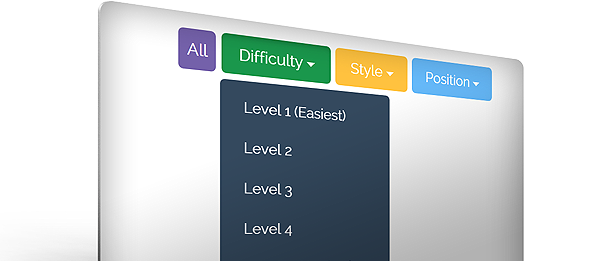
If you're a beginner, you can start with easier songs and build up to the advanced level.
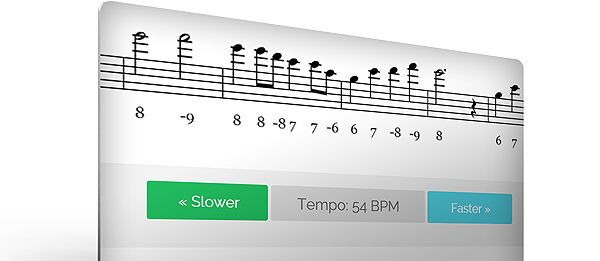
One of the secrets to successfully learning a piece with accuracy is to start slow. Once you master a song playing slow, you can make it a game to challenge yourself to play a little bit faster every day. My Jam-Along Song System makes this easy, because you can control the tempo as you progress.
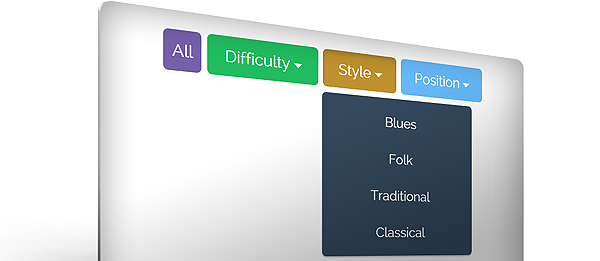
Expand your repertoire with my Jam-Along Song System, which offers a great selection of music — blues, folk, traditional, and classical.
With my Jam-Along Song System, you get 50 great songs … PLUS 25 bonus blues solos … PLUS 75 recordings of professional harmonica performances.
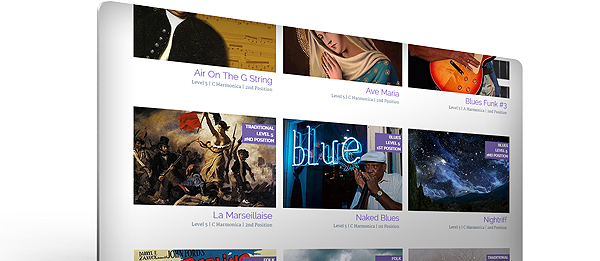
Many of the pieces include a jam section, where you can jam along — either repeating the melody notes or improvising on your own!
This is not just a "thrown together" collection of some of the most popular harmonica songs and awesome blues solos. It's much more than that. It's a complete course which will take you to advanced levels of performance ... step-by step ... song by song. Check out how the Road Map works in this video:

I love your new harmonica song system. The variety of songs and genres is great. I love that you can search by song title, difficulty level or genre. I also appreciate that you have the ability to speed up or slow down the player as your level of play changes. One other feature I really like is that you can see the entire song on the screen rather than waiting for the curser to scroll down while the music is playing. I'm addicted!
I developed the Jam-Along Song System with the help of some of the finest harmonica players on the planet, over the course of two years. These teachers include Joe Powers, Michael Rubin, Michael Brebes, Sam Friedman, JP Allen, and Jason Curran.
This means not only that you'll learn and hear some phenomenal original perfomances but also that ALL songs included with the system are deadly accurate, to the note (no need to suffer with annoying incorrect harmonica tabs any longer)





Instant access as soon as you order
Money-back guarantee
Compatible on all computers, laptops, tablets + mobile devices
Includes real harmonica performance audios
If this product does not skyrocket your ability to play harmonica songs (and sound good!) in 60 days, we will refund your money — no questions asked.
All you have to do is contact me and I'll get back to you fast: Contact Us Here, or call my support team on 1-800-292-4963 within 60 days of your purchase and Harmonica.com Will Give You a Full Refund (No Questions Asked)
Why do I offer this guarantee with such confidence? Simple: you will not find an easier or more effective way of learning actual harmonica songs, at your own speed, anywhere else. Also, if you learn one song each week, there are enough songs to keep you going for well over a year!

You have 8 balls; one is heavier. How many weighings on a balance scale do you need to find it?
Quantitative interviews, also known as quant interviews, are a crucial step in the hiring process for quantitative analysts, data scientists, and other roles that require strong mathematical and analytical skills. These interviews are designed to test a candidate's technical knowledge, problem-solving skills, and ability to think on their feet.
You are given an array of numbers from 1 to 100 with one missing. How do you find it efficiently? Trailing Zeros: How many zeros are at the end of 100!?
Never neglect the human element. You will likely be asked to describe a time you failed, why you want to work for that specific firm, and how you handle conflict in a team. Strategic Preparation Tips 150 Most Frequently Asked Questions On Quant Interviews
Define Delta, Gamma, Vega, Theta, Rho – what does each measure, and why is it important? Q137 - Q138: What is Delta hedging? How often must you rebalance? Q139 - Q140: Explain the difference between implied and historical volatility. What is a volatility surface?
Explain the concept of memory alignment and how unaligned data impacts CPU execution speed.
𝜕f𝜕S=1S,𝜕2f𝜕S2=−1S2,𝜕f𝜕t=0the fraction with numerator partial f and denominator partial cap S end-fraction equals the fraction with numerator 1 and denominator cap S end-fraction comma space the fraction with numerator partial squared f and denominator partial cap S squared end-fraction equals negative the fraction with numerator 1 and denominator cap S squared end-fraction comma space partial f over partial t end-fraction equals 0 Substituting these values into Itô's formula yields: You have 8 balls; one is heavier
How does a hash map work, and what is its average lookup time?
A clock shows 3:15. What is the exact angle between the hour hand and the minute hand?
e−x2e raised to the exponent negative x squared end-exponent −∞negative infinity ∞infinity These interviews are designed to test a candidate's
How many times must you shuffle a deck of 52 cards to make it truly random?
Probability forms the baseline language of quantitative risk assessment. Stochastic calculus extends this language into the continuous space required to model asset prices and derive option pricing mechanics. Key Concepts to Master